Shoutbox


|
Diversity
of
Movements
|
 tag please tag please |
 Meet the Owner Meet the Owner   This Blog will contain everything that related to DANCE. This Blog will contain everything that related to DANCE.Since I like dancing too, I will share some of my favorite dance types, dance moves, famous dancers, and ofcourse some tutorials to help you learn the steps :D I hope this blog can help you with your dancing! Enjoy ^_^  “All that is important is this one moment in movement. Make the moment important, vital, and worth living. Do not let it slip away unnoticed and unused.” ― Martha Graham |
 affiliates affiliatesLink |
|
 Tuesday, November 27, 2012 @ 11:41 AM Tuesday, November 27, 2012 @ 11:41 AMMoonwalk
The moonwalk is a dance technique that presents the illusion of the dancer being pulled backwards while attempting to walk forward. A popping move, it became popular around the world after Michael Jackson executed the dance move during a performance of "Billie Jean" on Motown 25: Yesterday, Today, Forever on March 25, 1983. It subsequently became his signature move, and is now one of the best-known dance techniques in the world.   
WRONG EXAMPLES OF MOONWALKING
 
MOONWALK TUTORIAL
credit: ElasticIllusion wikipedia Labels: dance, dance moves, dance tutorial, michael jackson, moonwalk, moonwalking, popular, tutorial back to top? |
|
|
Tuesday, November 20, 2012 @ 8:54 AM Tap Dance
Tap is an exciting form of dance in which dancers wear special shoes
equipped with metal taps. Tap dancers use their feet like drums to
create rhythmic patterns and timely beats. The term "tap dancing" is
derived from the tapping sound produced when the small metal plates on
the dancer's shoes touch a hard floor or surface.
TAP SHOES
 
TAP DANCE TUTORIAL
credit: themoneyfoot JOHNATHANCSCOTT dance.about.com Labels: dance moves, dance tutorial, tap, tap dance, tutorial back to top? |
|
|
@ 8:52 AM Saman
 Saman (or dance of thousand hands) is one of the most popular dances in Indonesia. Its origin is from the Gayo ethnic group from Gayo Lues and is normally performed to celebrate important occasions. This dance is done by a group in one line (sometimes with some displacement) and dancers perform while kneeling. On November 24, 2011 UNESCO officially recognized Aceh's traditional Saman Dance as an intangible element of world cultural heritage, which needs UNESCO's urgent protection. The ASEAN Tourism Association (ASEANTA) named on Saman Dance as the best ASEAN cultural preservation effort at the 25th ASEANTA Awards for Excellence 2012. This is a traditional dance from a region in Indonesia.
Saman dance movements using two
elements of the basic elements of dance saman: Clap clap hands and
dada.Diduga, when spreading the religion islam, sheikh summons wilt
learn the ancient dance, and then to re-pass the motion, along with
poems by Islamic missionary preaching memudakan . In the present
context, dances are religious rituals that are still used as a medium to
convey messages preaching through the shows.
Saman
dance including one dance that is quite unique, because they only show
the motion of applause other movements, such as shaking movements,
kirep, lingang, surang-filtering (all of this motion is Gayo language)
SAMAN TUTORIAL
credit: Riasinta FarrasFiansa wikipedia wahyu89culture Labels: Aceh, dance tutorial, Indonesia, Indonesian dance, saman, saman dance, tari saman, traditional dance, tutorial back to top? |
|
|
@ 8:29 AM Tutting (King Tut)
Tutting is a style that is based totally on geometry and patterns and
angles, mosty with your arms. It is a great style for feeling like you
are building puzzles or boxes and there are an infinite number of
patterns you can create. Once you learn the basics. The basics
of tutting mostly involve learning the basic angles and how you can move
between them. And then a LOT of drilling. You need to know that when
you lift your arms, they are in the position you think they’re in. Once
you have that down, you can start freestyling your tuts and go for days.
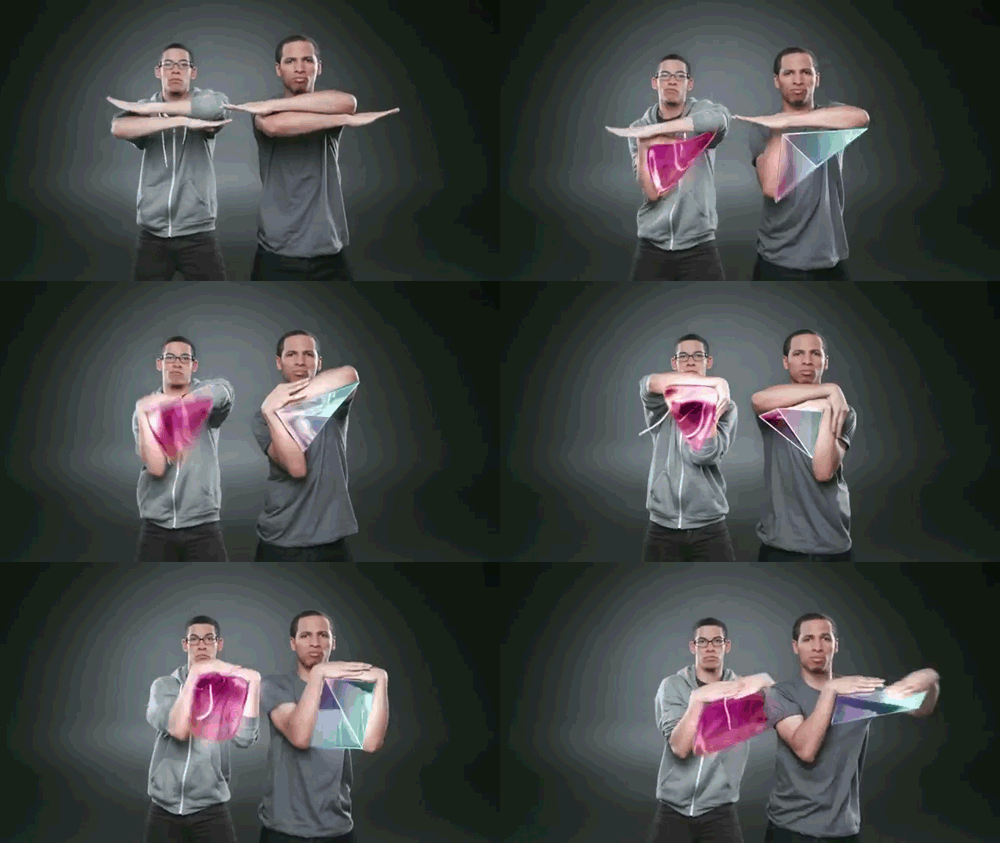
Finger Tutting
     The 5 Basics of Tutting90 degree anglesLet’s begin with the most obvious. Tutting is based pretty much entirely on 90 degree angles. All of movements involve your elbows and wrists being at 90 degree angles to the rest of your body. This is the reason it’s called tutting. It’s like the Egyptian tut poses in all of the tombs. Now, making 90 degree angles is harder than it sounds and a lot of people end up with what we all used to call duck tuts, where the hand is bent at the knuckles into the shape of a duck’s beak. Also, when you are doing outer tuts, there can be a tendency to not lift your elbows up to 90 degrees (to where there is a straight line from one elbow, through the shoulders, to the othe elbow). It’s HARD to lift your elbows that high. You usually feel strain in your shoulders. It wears you out. But this is the price of excellence. You gotta WORK IT OUT. Wrist rolls Wrist rolls were made famous by Mr. Wiggles but are used by almost all tutters. They are an incredibly amazing technique because they are super easy to do and super dope looking. They have a lot of bang for the buck. All that wrist rolls involve is rolling your wrists so that your hand moves in a circle from one side to the other. You can throw them in at any point. You can hit an angle and then roll the wrists. Then hit another angle. Then roll the wrists. It can go on forever. You can flip it in so many ways so it never gets old. Definitely practice the wrist rolls. Incorporating your whole body It’s important to practice incorporating your whole body from the start because it’s really easy to turn into a stand-still tutter who doesn’t move and just moves their arms around. You might come up with cool poses, but it doesn’t have the same dope dance feel as when you use your whole body. This is especially true for the flexers out there. They have so many incredible combos and concepts but they are usually just standing there and executing. They don’t really move or dance through their tuts. One good way to practice this is to tut on one leg and move the other leg into tut angles while yout tut your arms around it. Bend forward, duck down, hit ground moves, bend to the side. Moving with your tuts adds a LOT to the possibilities. Adding texture I learned this concept from Tetris who learned it from Mori. When Mori first saw Tetris tutting, Mori told him–nice, but ADD TEXTURE. Adding texture means changing rhythms, strobing your tuts, moving at different speeds, hitting sometimes… basically, switching it up. Tutting can get old quick if you don’t switch it up, because it can just look like tut-tut-tut-tut-swing-the-hands. But if you add a whooooooooooosh and a tick-tick-tick and a fast-slow-fast-fast-fast, people will never know what’s coming next and they will become your biggest fans. Tut to the Beat This should be obvious, but just in case it’s not, do your tuts to the beat of the music. The music should inspire your tutting and help you come up with new patterns and new ways of doing your existing patterns. When you tut to the beat, the tuts flow with the music and you can really accent the music, which always gets points with the audience, the judges, and the opposite sex. Start with basic rhythms like 1-2-3-4 and then you can work your way up to more advanced rhythms and beat freaks. The Wrap-Up Learning and applying the basics of any style are the way that you really become a DANCER. You can piece together 10 tut sets and do the same routine over and over and that’s cool! But to really become a bona fide tutter, you need to take the basics of the style and come up with your own ways to flip them.
Finger Tutting Tutorial
credit: HowcastArtsRec westcoastpoppin Labels: dance, dance moves, dance tutorial, finger tutting, king tut, tutorial, tutting back to top? |
 monthly archive
 recent entries